
- Zero mystery breakages—when prompts change, everyone knows
- Faster onboarding—'here is the prompt file; everything is inside'
- Easier audits—'which prompt version generated this?' has an answer
- Industry
- Technology
- Stack
- Markdown, Python, Git
Problem
Prompts and model settings scattered across codebases make audits painful and changes brittle.
Constraints
Must support multiple workflows, evolving schemas, and multiple models without rewriting half the app.
The Approach
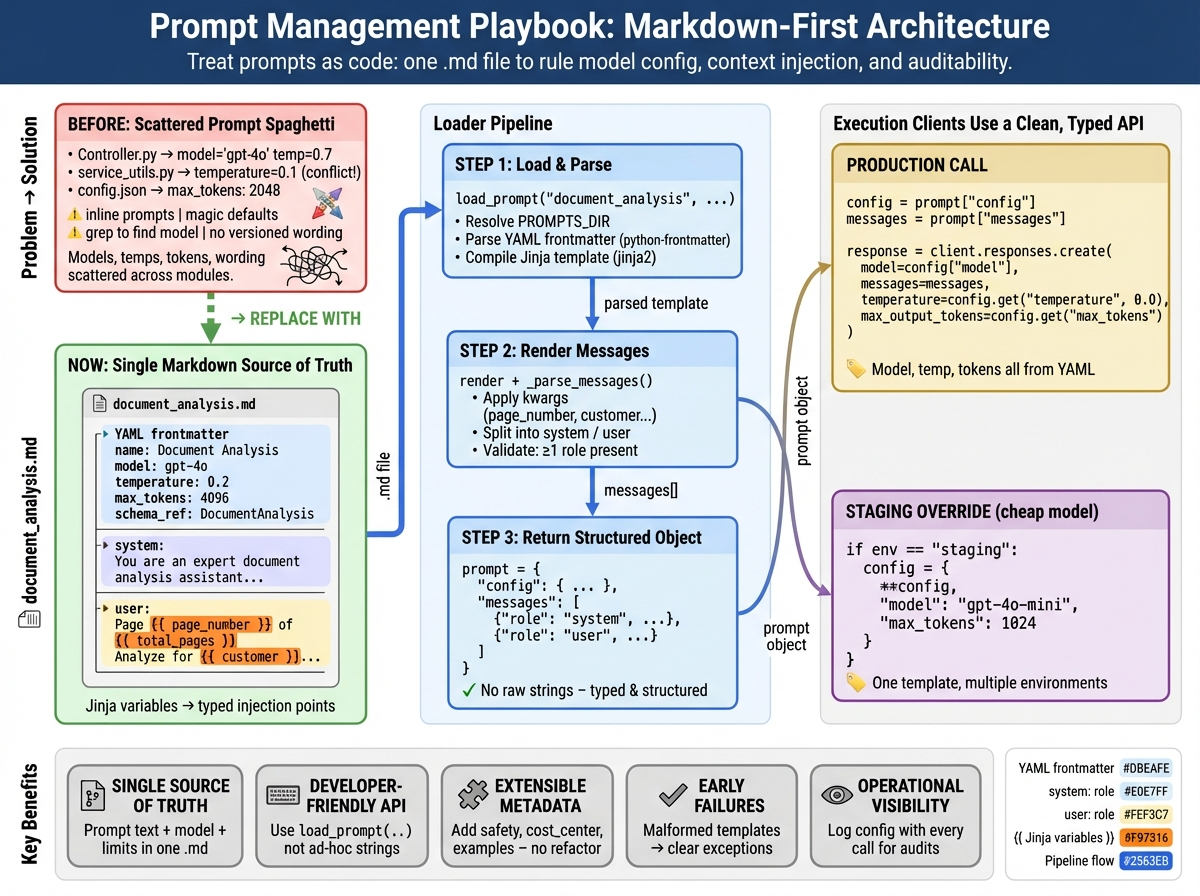
Put prompt text + config + schema expectations into a single versioned template file, loaded by a strict runtime.
Faster iteration, fewer regressions, and a clean review workflow where changes are obvious.
Context
This playbook is for teams building LLM features that must be maintainable—and ideally compliant. It emerged from watching too many projects fail in predictable ways.
My role: Designed the approach + templates + runtime contract.
The Problem
Classic LLM implementations fail in predictable ways:
- Scattered configuration. Prompt text lives in one file, model settings in another, schema expectations somewhere else.
- Silent breakages. Engineers “just tweak the temperature” and the output format breaks downstream.
- No version history. Nobody knows which prompt version produced which output.
- Archaeology debugging. “Which string concatenation did this come from?” becomes a real question.
When you can’t trace outputs back to inputs, you can’t debug. When you can’t debug, you can’t iterate. When you can’t iterate, you ship broken things.
Key Decisions
-
Single source of truth per prompt. Configuration + instructions + expected output live together in one file.
-
Version control by default. Prompt changes are code changes—reviewable diffs, not Slack messages.
-
Strict interfaces. Prompts produce a known structure. Failures are detected early, not in production.
-
Separation of roles. Writers can refine text; engineers can enforce contracts. Neither blocks the other.
Solution Overview
Each prompt is a template artifact with:
- Metadata: Purpose, version, model constraints
- Input requirements: What context must be provided
- Output requirements: Schema / structure expected
- Prompt text: Human-readable, editable
The runtime:
- Loads the template
- Injects context safely
- Validates output shape
- Logs prompt version + config used
What I Built
- Prompt template format: Human-readable with structured metadata
- Loader contract: Consistent API to render prompts with context
- Validation hooks: Detect malformed outputs early
- Change workflow: Prompt updates via PRs with reviewable diffs
Outcome
- Reduced mystery breakages. When prompts change, everyone knows.
- Faster onboarding. “Here is the prompt file; everything is inside.”
- Easier audits. “Which prompt version generated this?” has an answer.
- Clearer collaboration. Product, domain experts, and engineering can all contribute.
What I Learned
The playbook works, but it’s the beginning, not the end:
- Prompt tests are worth it. Golden inputs with expected structure catch regressions before they ship.
- Eval harness is next. Regression detection across model upgrades requires systematic comparison.
- Stakeholder visibility matters. A small prompt catalog UI (read-only) lets non-engineers see what’s deployed.
- Schema evolution is hard. When output requirements change, you need a migration strategy—not just a new prompt.